The Other MAGA
The Democratic Party is struggling to escape its own retrograde "restoration" mindset

Too much has been written over the past several months about the divisions in the Democratic Party between progressives and centrists, what they mean for the coming midterm elections, and whether they demonstrate a generational shift toward the left in the Party. Some of this discussion - maybe even a lot of it in some quarters - is intended to damage the Democrats, but I don’t have a problem with the topic overall. Enough is enough, but the discussion is interesting, especially to me, a Democratic Socialist who consistently votes for Democrats.
Here is a fairly good example from this morning of how this conversation is carried out by sympathetic characters on a major legacy media platform, the New York Times:
I especially like Jamelle Bouie and his ideas, many of which are more incisive than those he presents in this piece. As so often with these proprietary presentations from the NYT and other legacy media, the participants try to cover too much ground, prevaricate and waffle a bit too much, and end up after many minutes having said relatively little. It’s elevated infotainment, but not bad if one recognizes its limitations.
MAGA and Democratic or Alterna-MAGA
I think there is a better way to look at this situation, however, one that more concisely and completely describes the differences in the Democratic Party, broadly defined:
The Democratic establishment and many professed Democratic centrists support Democratic MAGA. A diverse group of Progressives, Democratic Socialists, outsiders, and populists are trying to break Democratic MAGA. One side takes a short-term, managerial approach; the other takes a more radical systemic approach. The latter, the proponents of systemic change, are pushing against those who seek only a restoration of Democratic electoral success within the present system.
Looking back on the past decade or more in American politics, including the Biden Administration, it is hard to deny that the rise of Donald Trump and MAGA and their capture of the Republican Party have been the top story, the dominant narrative and the most consequential development. The implications are severe - rampant oligarchic control of American economy and society, the erosion of the rule of law, the rejection of science and the empowering of the most destructive elements of capitalism, to name a few. Many, many authors have dealt at length with the horrific consequences of this evolution (or devolution) of the United States, for our country and the world.
Against this background, the Democratic Party likes to present itself as anti-MAGA. That includes the Democratic establishment. Anti-MAGA was the leitmotif of the Biden Administration in all that it set out to do (quite ambitious) and did (much less consequential than expected).
But Biden was not anti-MAGA. He and his Administration, and the Democratic Party under his leadership, were other-MAGA. Or, as I prefer, alterna-MAGA.
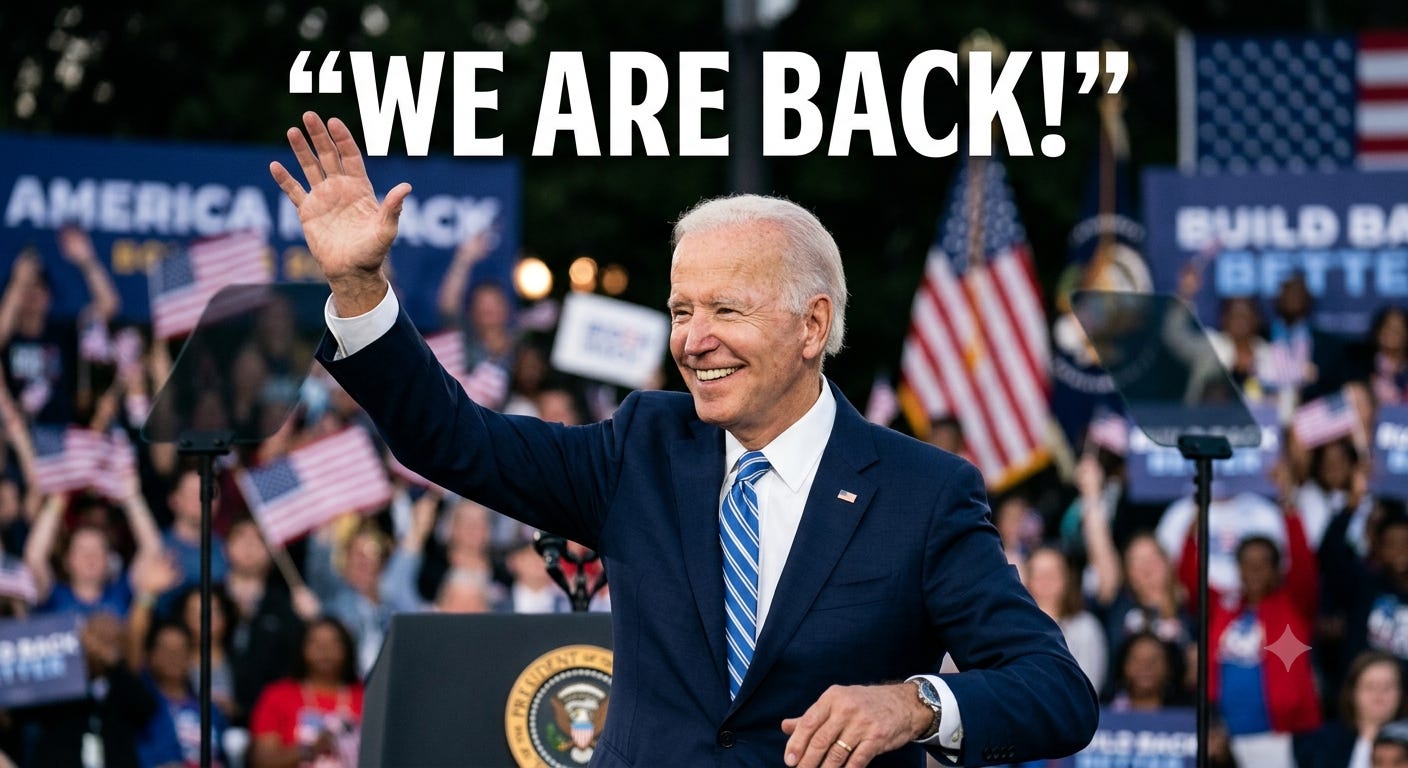
Biden’s We Are Back was the B-side of Trump’s Make America Great Again, not its antithesis. Build Back Better was its domestic formulation. It was an alternative restoration project, not a path to the future.
The Vague Nostalgia of MAGA
MAGA is vague about the time and conditions it seeks to restore in national life:
Does it include Jim Crow?; Does it impose Christianity?; Should companies be allowed to pollute?; Do public lands really belong to the public, and aren’t mining and oil companies part of the public anyway?; Is climate change a problem?; Should gay marriage exist?; Is all immigration bad? Should Social Security be privatized? Do the poor deserve to suffer?
MAGA is just a jumble, a blank slate that accommodates every form of bigotry and prejudice and boutique nuttery and conspiracy theory. For some it includes Jim Crow, for others the Rapture or Crypto or MMA, while for others still it has to accommodate Medicare. That is why MAGA is such a successful branding exercise and such a crappy political movement; it is always at risk of being turned toward a set of ideological objectives (such as Project 2025) that puts strain on its all-enveloping, abuse-tolerating, defiance-performing nostalgia. That is also why MAGA cannot, to my mind, survive Trump. Trump has often been called a “branding genius”, and he may have earned the moniker in this case (though I find it hard to stomach such close juxtaposition of the words “Trump” and “genius”). MAGA is Trump’s brand, and only he can obscure and overcome, through his personality and alleged charisma, the debilitating contradictions at the heart of the MAGA coalition. Trump has often said “I am MAGA.” Let’s grant him that. Trump is MAGA.
Obama and Alterna-MAGA
What about alterna-MAGA? Biden’s We Are Back and Build Back Better. The restoration project that Biden promoted and that remains so dear to much of the Democratic establishment. What about that?
It is likewise vague about the time and conditions it seeks to restore in national life. Most obvious is a nostalgia for the Obama Era. There is the intense devotion to Barack and Michelle, and to their friends - most notably Oprah. One can indeed say many good things about the Obamas and their time in the White House, particularly their pathbreaking role as African Americans and their personal probity while in office. Barack Obama clearly exuded charisma.
But the Obama presidency is perhaps most remarkable for the modesty of its ambitions and its devotion to the system that exists in the US. The Obama Administration restored financial stability by protecting banks while sacrificing small borrowers. The Affordable Care Act, or Obamacare, was a notable manifestation of political realism that helped many people, but it did not challenge the basic inequities of our for-profit health system in the United States. Instead, it played on the margins. Similarly, in foreign policy, Obama’s achievements and failures were very modest and marginal. There was lofty rhetoric but no vision, no drive. Obama came to office promising to close Guantanamo but quickly gave up. He oversaw the capture of Osama bin Laden but also stepped up targeted assassinations of terrorist suspects abroad, despite a horrible record of mistakes and “collateral” casualties. Although Obama won the 2008 election in part because he opposed the invasion of Iraq in 2003, he vacillated once in office, overseeing futile “surges” in both Iraq and Afghanistan while in the White House. He stoked the Arab Spring and then quickly washed his hands of the Arab reality. It was the same on social issues. Obama came around very slowly on same-sex marriage. He was remarkably conservative in office.
I suppose I should not be surprised that a professor of constitutional law would show a lack of imagination when it comes to novel solutions to our country’s problems, but I am still astounded at the very low level of ambition Obama demonstrated as president. After his first two years in the White House, he was hemmed in somewhat by GOP majorities on the Hill, first the House of Representatives in 2011 and then the Senate in 2015. But he truly pulled in his horns, surely more than was necessary. Obama also seemed unduly impressed by his access to the highest echelons of the American economic and cultural elite. He seemed perfectly content to tweak the system within very narrow limits, and to carve out a safe and comfortable private life for himself and his family after leaving office. To use an over-used phrase, the Obama Years have not aged well.
The Defensive, Self-Limiting, System-Serving Essence of Alterna-MAGA
Cuing off Obama, Biden and other “restoration” Democrats since have defined their alterna-MAGA within narrow limits. Their aims are best understood in the conceptual constraints they sets themselves:
Should we assert our devotion to capitalism or show some socialist leg? Are market-based solutions always best? Can’t we just tweak regulations and thereby transform outcomes without hurting anybody? Can’t everyone be patient enough to allow a modest program of redistribution that inflicts minimal pain on the affluent play out over a decade or two? What about all those high-income voters who might turn against us if we raise their taxes or even their Social Security contributions? Aren’t our largest, champion companies our economic national champions? Even if what’s good for Wall Street is not good for Main Street, isn’t what’s good for Wall Street good for me and the US? Do I care about unions or just union votes? Will we lose gay marriage if we support a broader range of LGBTQ rights? How do we defend immigration when it’s not always popular to do so? Is immigration even good? Isn’t American primacy good for everybody, and don’t we need to beat China, whatever that means? Isn’t Israel our best ally in the Middle East, and don’t we owe them our support? Shouldn’t market-based solutions to climate change be all we need?
The other focal points for alterna-MAGA nostalgia are LBJ’s “Great Society” and FDR’s “New Deal”. On foreign policy, alterna-MAGA nostalgists love Truman and the beginnings of the Cold War. In other words, they admire periods of genuine redefinition of social, political and economic relations in the United States, and between America and the world, under Democratic presidents. Alterna-MAGA types even contend that the high marginal tax rates under Eisenhower, and Eisenhower’s warnings about the military-industrial complex, belong to Democrats as much as Republicans, thereby invoking another of their favorite themes - bipartisanship and a longing for amicable centrism.
More and More Americans Want Systemic Change
But more importantly, like MAGA, alterna-MAGA is entirely defensive. Democrats may have carped that Make America Great Again implies that America is no longer great. Touché! But Democrats clearly believe in American decline as much as Republicans do, if not even more so. It is simply a fact of life, obvious to everyone here and abroad. In place of MAGA, establishment Democrats offer another, slightly different version of the past as the limits of what America can be. They are trapped in the 20th Century, the time of FDR, Kennedy, LBJ, and Clinton. They look back fondly to LBJ and FDR not as examples of political innovation and courage, but as the Democratic leaders who defined American greatness - including its limits. They want to preserve as much as possible of what was achieved by FDR 90 years ago, and by LBJ 60 years ago. In that they are still like Bill Clinton. Their message to voters: “that is enough; this will have to do.”
Yet the 20th Century is receding in the rear view mirror, increasingly irrelevant as we move ahead in a world that has been profoundly transformed. More and more of us were born after 1999. By that point - more than a quarter century ago - our national trajectory was downhill - and we continue our slide under Democrats and Republicans. Voters want more than a celebration of history and “accept these limits” scolding. They especially DO NOT want to hear “Who’s gonna pay for this?!” from Democratic officials who support massive defense spending and global primacy and take election contributions from big banks and big business. No more lectures, please, to tell us this is how things have to be because this is how they have always been. We want to see ambition and innovation matching the magnitude of the challenges before us. We want to see a will to fight that matches the injuries and indignities that we have suffered.
Increasingly, we want systemic change.
This is why so many in the Democratic Party are screaming against the Democratic establishment and demanding a more radical approach. Many of those voices, and many of the most strident, come from the Left. Mamdani. Bernie. AOC. Warren.
Robert Reich is one such voice on the Left. He has begun work on a series on Substack that lays out a “Realist’s Guide to the American System”. I think it’s brilliant. The key word is “system” - we need a systemic approach, because the problems are systemic. The first weekly installment appeared yesterday. Here is a link:
But there are also some very powerful voices rising from other parts of the Democratic spectrum, like Talarico in Texas, Ossof in Georgia. Even Pritzker in Illinois. They are mainly young. To my mind, this is not because of a drive for generational conflict, but a reflection of a perception of reality that is broadly shared among young people - including grave disappointment in the system as it exists - and the huge stake they have in the choice between stasis and change. The present system does not work for the vast majority of us, but the implications are much more ominous for the young. And young people are on the whole more creative, more integrative in their thinking, than those who are older. I am nearly 68 years old and make a conscious effort to stay open to new ideas and learn more broadly, but I am also aware that I was smarter and more intuitively systemic in my thinking as a young man. All I have to do is open one of my old college blue books from the 1970s (I still have a few around; I am that kind of guy).
Against MAGA and Against Alterna-MAGA
The fight, in other words, is against both MAGA and alterna-MAGA. It’s a bitter fight, and it will surely get uglier, regardless of the outcome of the midterm elections in November. Because the stakes are high. They are about more than elections or electoral politics. Only those who seek systemic change are truly oriented toward the future, in my mind. They want new, more radical solutions to address new, more challenging problems. I see that modeled by Mamdani and AOC and Talarico.
There is another possible opening, as well, something potentially catalytic that is too often dismissed as the convergence of right-wing and left-wing populism. It is a broad upwelling of demands for systemic change that draw on disaffected MAGA supporters and more ambitious opponents of alterna-MAGA on the left. They have more in common than we sometimes realize, and many in the establishment - especially the Democratic establishment - find that unsettling. I think they are painfully mistaken. It is a good thing. Populism has its risks, but the nostalgia-obsessed alternatives - MAGA and alterna-MAGA - offer no hope at all for the future.
“As so often with these proprietary presentations from the NYT and other legacy media, the participants try to cover too much ground, prevaricate and waffle a bit too much, and end up after many minutes having said relatively little. It’s elevated infotainment, but not bad if one recognizes its limitations.”
This is so true. My generation would call it a “truth-nuke”.
Well framed. Systemic change seems to happen under two conditions: 1) broadly shared prosperity/security, 2) broadly shared extreme suffering. The nature of our system is legal stability by constitutional design (admittedly Congress has abdicated its responsibilities of late). Systemic change therefore requires unusually high levels of public support for change. We may well see that level of support on economic issues relatively soon but it is difficult to see such an outcome on the social/cultural side. Systemic change will probably require a two step - first successful economic changes, then social/cultural changes built on the foundation of economic security. Intersectionality is foundational to systemic change but in such change may falter on the shoals of intersectionality.