My Semiquincentennial
Celebrating the Washington Writers' Project and The American Guide Series

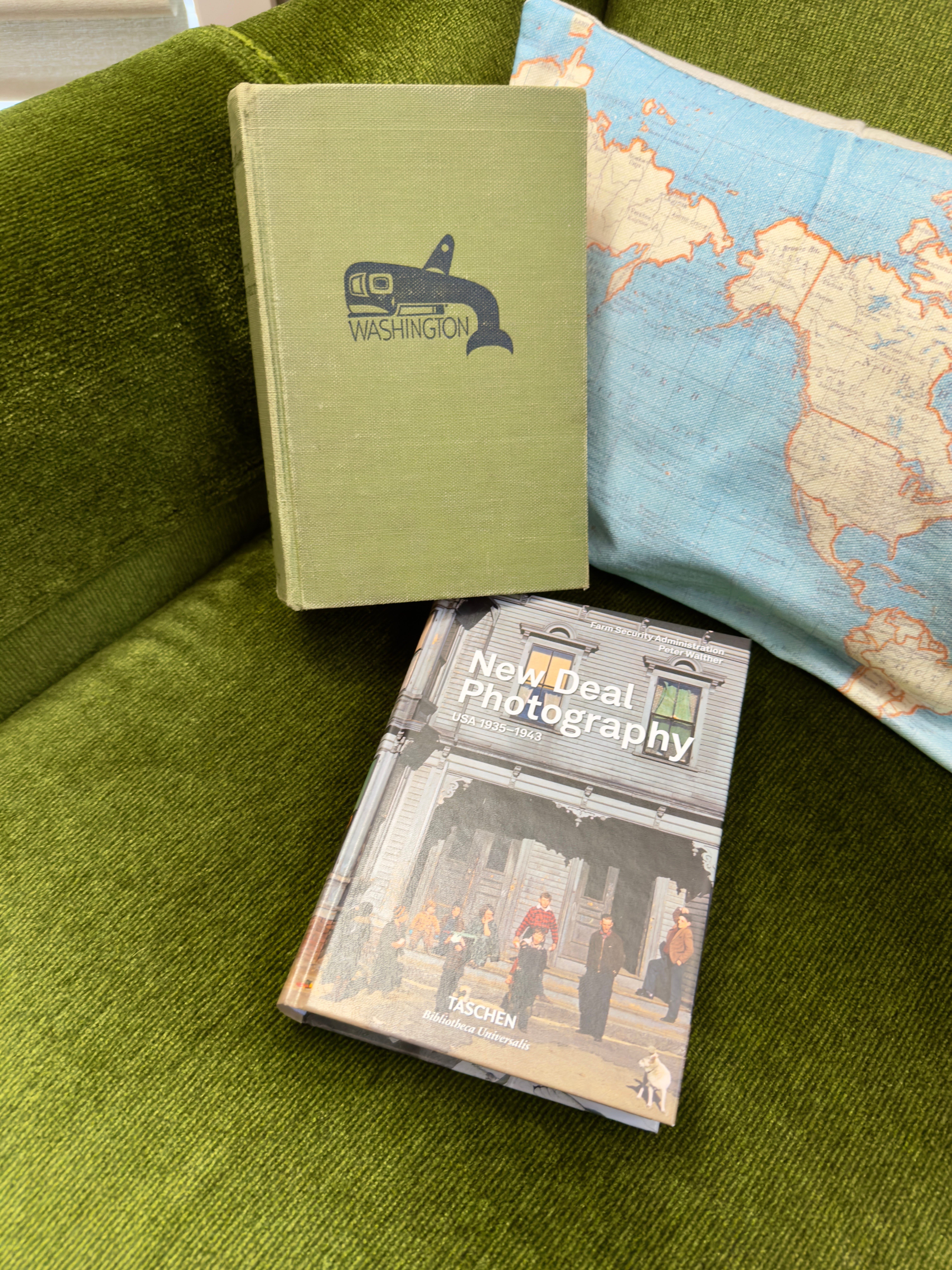
I don’t know what to think about the Semiquincentennial of the Declaration of Independence. Perhaps it’s just me; I find it hard right now to celebrate this country that I love. Too much is going wrong in our government, economy, society and culture. On top of it all there is Trump, who keeps debasing everything with his name, guise and toxic spirit. Tomorrow is Trump’s White House cage fight extravaganza, which somehow rolls the President’s 80th birthday and signature grift into our national anniversary events. That is only the beginning. It is encouraging that Trump’s name has been removed from the Kennedy Center; that’s one down. Still, we’re losing ground. The coming month(s) will be rough.
I vividly remember the Bicentennial back in 1976, and even though it fell at a time of national troubles - the oil shock, the end of the Vietnam War, the Watergate Scandal and Richard Nixon’s resignation - it carried a sense of national renewal, of finding strength in our roots and moving forward on a healthy and more human basis toward a positive future. I love travel literature, and to me, two wonderful travel books captured the Bicentennial zeitgeist: Walk Across America by Peter Jenkins (1979) and Blue Highways by William Least-Heat Moon (1982). Blue Highways, in particular, remains a true classic of the genre.
50 years ago, back in 1976, there were complaints that America’s birthday celebration was overly commercialized. In retrospect, I’ve just gotta laugh at how innocent we were. It was really so wholesome, so rosy-cheeked and wide-eyed. If we had only known …
It is not easy to find such a sense of renewal and optimism in 2026. I still look for books, especially travel books, to capture the moment and help me focus my thinking. This time, I had to look backward well beyond the Bicentennial to find what I was looking for: The American Guides Series. As Trump does his best to distort our history, degrade our memorials, commercialize our natural treasures and cheapen our national life in countless ways, The American Guides are a monument from the 1930s and 1940s that he cannot touch, a kind of light to shine through our present disillusionment.
I first encountered The American Guides as a graduate student in Washington, DC, in the early 1980s. Roaming used bookstores (as I still love to do), I picked up a copy of Washington, D.C.: A Guide to the Nation’s Capital. Published in 1942, it was a minor revision of the second volume in the Guides Series - Washington: City and Capital, which appeared in 1937. It was already long out of date in some ways when I first cracked it open, but I was enchanted all the same. The book was exhaustive and detailed, like the famous Blue Guides in Europe, or even the old Baedekers. As in Baedeker, the pages were packed with all sorts of practical information - stores, post offices and their hours, bus routes, train timetables - along with a good deal of well considered commentary. Reading the book involved time-travel, not just sightseeing and practical advice. Still, four decades and more after publication, Washington, D.C.: A Guide to the Nation’s Capital was the best guide to Washington back then. It probably remains so today, almost 50 years after I encountered it, and almost 90 years after it first appeared.
Another volume in the Guide Series has captured my imagination since I retired from the Foreign Service and returned home in 2015 - Washington: A Guide to the Evergreen State. Published in 1941, it includes amazing descriptions of the major cities, towns and sights of Washington State along with numerous Tours, i.e., itineraries along roads that sometimes no longer exist. It fires lots of synapses in my memory and family history and conjures places, events, terms and customs that I half-way knew. The book is an illuminating and nostalgic guide to exploring my home state, whether from an armchair or behind the wheel.
I will have a lot to say about this book over the coming months (and maybe years). Let’s begin, though, with the thing about it that charms me the most: it’s proud embrace of the egalitarian spirit. Or, more properly, the worker’s spirit and elan.
It is worth noting that the authors of Washington: A Guide to the Evergreen State are anonymous. As with most of the books in The American Guide Series, the authors’ names were omitted and are in fact very hard to find - anywhere. Some famous authors contributed to other books in the Series, writers like John Steinbeck, Richard Wright and Saul Bellow. Their role was later uncovered and recognized. All were members of the Federal Writers Project, part of the Work Projects Administration (originally the Works Progress Administration) and FDR’s New Deal. But none of the writers who compiled the 687 pages of the Guide to the Evergreen State are recognized or even, to my knowledge, known. They are credited collectively, on the Guide’s title page: “Compiled by workers of the Writers’ Program of the Work Projects Administration in the State of Washington.” I like that phraseology: “workers of the Writers’ Program”. It speaks to me of the dignity of labor - all labor. (I plan to search the archives from the Guide project, stored in Tacoma at the Washington State Historical Society, for more about the authors. They were paid; there must at least be receipts, with names and possibly other clues.)
Curiously, the photographs in A Guide to the Evergreen State are duly credited, including to individual photographers. The Writers Program and the Federal Writers Project ran in parallel to the Dust Bowl-era Resettlement Administration/Farm Security Administration (FSA), which employed the photographers who produced what is sometimes called New Deal Photography. They created many of the most evocative and haunting images of America ever made; some of their works are famous and truly iconic. Among the FSA photographers were several big names, including Dorothea Lange, who worked in Washington State. It is odd to think that individual attribution was given to the relatively small group of photographers but not to the far more numerous writers; one has to wonder why. (The photographic archives of the Washington Guide project are also stored in Tacoma.)
The egalitarian spirit of Washington: A Guide is most evident in the 150 introductory pages, which review the history of the Evergreen State and key aspects of its economic, social, and cultural life. Perhaps the most characteristic chapter in the story is the one on “Industry, Commerce and Labor”, a total of 27 pages. First and foremost, seen from our present perspective, it is startling that “Labor” is included in this chapter, or in the introductory section at all. But it is very much included, eight lively pages about the struggles of working people to organize and advance their interests in the face of serious and sometimes deadly pushback from business interests, the conservative press, and local and state authorities. The text covers grassroots organizers, the Wobblies, strikes, riots, massacres, maneuvers between the AFL and CIO. It showcases workers’ demands, resolve and achievements. It is an uplifting, expansive story. Indeed, belief in worker rights bleeds over into the sections on “Industry” and “Commerce”, as well, and pops up intermittently throughout the entire book.
Thus, in important ways, A Guide to the Evergreen State shows how much ground we have lost on critical issues over the past eighty years. It demonstrates how we have grown desensitized to core economic dimensions of political and social life, how truncated and unbalanced our national discourse has become. It lays bare the cynicism which clouds and obstructs open and constructive discussion of contesting economic interests in today’s America and Washington State.
Missing from Washington: A Guide to the Evergreen State, however, is an appreciation of racial and other forms of discrimination and the struggle for civil rights and equality. There is a patronizing and sometimes disrespectful treatment of minorities and, to a degree, women. It is an everyman sensibility that marginalizes the marginalized. In that sense, the book is backward - blind or at least insensitive to principles and issues that are very important today. That, too, is illuminating.
In other words, reading the Guide to the Evergreen State is a good way to understand what we have lost and what we have gained - in Washington and America - over the course of my lifetime. It gives cause for hope and for faith in the possibility of renewal. In the depths of the Great Depression, our system changed and centered the perspectives and interests of working people - or at least came close. It brought them out of the shadows, even while others remained in darkness. If we did it then, however imperfectly, we can do it again, and perhaps rather better this time. The arc of history is long indeed; who knows where it leads. Perhaps, through consciousness and struggle, we can nudge it in the right direction.
There is an American Guide Series guide to every state in the United States. Even Alaska and Hawaii were added on at the end, before statehood. You can probably find the Guide to your state in the local library, in a used bookstore, or online. Give it a look. Most follow a similar pattern, but for me, there is nothing like Washington. I was born here and now I am back; I feel a profound allegiance to this state. I truly love it. For me, exploring the 85-year-old Guide to the Evergreen State is not a bad way at all to mark the Semiquincentennial in the beautiful place where I live - Bellingham, The City of Subdued Excitement. Our unofficial mascot is the sloth, but people work hard here. We are a city where working people deserve more. They deserve to be centered.
Bellingham is a fine American place in 2026. It wants to be so much better. It tries. I like to think that is true of all American places at the Semiquincentennial. In this difficult present, there is hope to be found in looking backward as well as forward.
Excellent essay. Uplifting, too. Hard to find these days, uplift.