Lost in Zeros
Americans' incapacity to do mental arithmetic is a national crisis

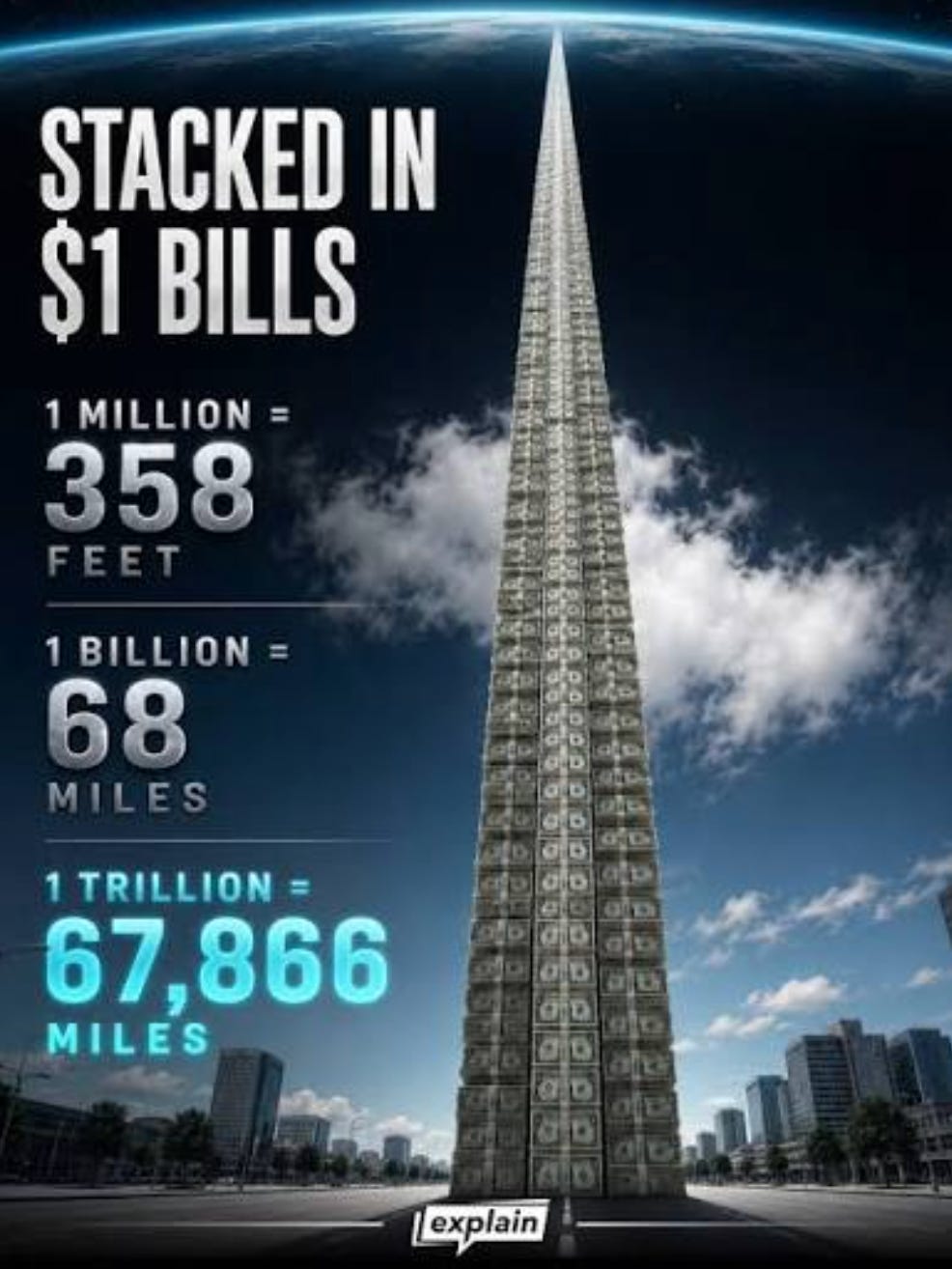
I often get the impression that many, many Americans - perhaps most - don’t really understand the world at all. They don’t understand science, they don’t understand economics, they don’t understand foreign affairs. I often doubt whether they even bother to try.
That attitude of mine is probably too snooty and basically unfair. But in one area I know that Americans are woefully inadequate in ways that make them awfully easy to dupe: mental math. Basic arithmetic, done inside your brain.
This will be a short article, because the observation is so simple and, I believe, incontestable. Americans can’t do mental arithmetic. They are drowning in zeros in ways that I sometimes find hard to fathom.
The Geddry newsletter is one of my favorite things on Substack, and it is usually informed by a strong grasp of pretty weedy stuff. In three words, I love it. But today’s update included a somewhat delusional discussion of Trump’s wild claims on Friday about the U.S. government’s investment in Intel:
[Trump] also informed his audience that the government’s stake in Intel had produced $82 billion in profit. “Do I get credit for that? No,” Trump complained. “Did anybody say great job?” Then came the necessary clarification: “It’s for the country. It’s not for me.” A few seconds later, $82 billion had become “about 80 billion,” with Commerce Secretary Howard Lutnick enlisted to certify that it was “pretty close to 80.” …
So there you have Friday according to Donald Trump: America is richer than any country has ever been, coal is beautiful, wind is a disaster, elections are rigged, MAGA is furious but not with him, Democrats may end Republican presidencies forever unless he ends the filibuster first, Iran may require another “hit,” and the government has apparently made both $80 billion and $82 billion on Intel, simultaneously, from the same stake.
Here is a link to the full Geddry article:
Geddry He Also Wanted the Gold
The problem is not the $2 billion discrepancy, though. The problem is much simpler - both $80 billion and $82 billion are completely beyond the realm of possibility for Intel’s profits. Recognizing this doesn’t take any serious knowledge about Intel, just a decent grasp of numbers, the economy, and a capacity for rudimentary mental math.
The most profitable US company is Alphabet (which owns Google), and it has an annual profit of about $160 billion on more than $400 billion in revenue. Trump made the U.S. government take a stake in Intel because the company was failing. That should shape our expectations about numbers. Intel’s total revenue has risen since, but it was just $16 billion in the last quarter, and the company lost money. It’s profit was less than zero.
Trump was evidently referring to an $8.2 billion cash infusion to Intel from a new investor. That has nothing, however, to do with revenue, profits or anything that Trump (or Lutnick) actually said, and was, of course, an order of magnitude smaller than the number Trump claimed.
In other words, the biggest problem with Trump's claim of $80 billion or $82 billion in profit for Intel is not that the numbers diverge a bit. It is that Intel is not nearly that big, profits cannot possibly be that high, and the whole thing is just complete gaslighting BS.
I don’t mean to come down hard on Geddry - as I said above, the newsletter that she and her colleagues run is superb, well-informed, and a whole lot of fun in a sardonic, Trump-era way. The problem is that if Geddry does not immediately recognize the phantasmagorical gaslighting in Trump’s Intel profit claims, who does?
I think zeros have become a national emergency of sorts. Americans have long been pretty pathetic at mental math. I have seen it in the classroom (where foreign students did much, much better), in my work as a diplomat, and in everyday life here in the Pacific Northwest. My expectations are honestly pretty modest on this one. I realize some math is really hard. Nobody needs to roll out a differential equation to impress me. I just think folks should be able to divide fairly small numbers accurately and spitball an order of magnitude calculation of the product of two fairly large numbers. Demonstrate a basic understanding of interest and compound interest, and what “discounting the future” means. Maybe even less than that - maybe just tell me, instantly, what the number 1 trillion is - Can you write it out? How many zeros are there? How many billions or millions are in it?
The proliferation of zeros has made things worse for a long time, and now it’s messing with people’s minds as far as I can tell. It’s as though the addition of more zeros just causes many of us to throw up our hands and say “beats me. I can’t deal with this.” It is not just childish; it is weird and somehow foolish. We’re just talking numbers here, after all. No need to convert our antiquated Fahrenheit scale to Celsius or our preposterous inches and pounds to centimeters and kilograms. We all have the same numbers. Numbers are abstract, which may make some of us nervous. But it’s just arithmetic.
It makes me want to gag when Trump says he has lowered drug prices by 200 percent. Still, I think just about everyone must recognize that is completely illogical. We all recognize that prices and fractions don’t work that way together, right? Right?
But the zeros problem exists on a higher and more abstract plane. It seems that a lot of Americans - even the ones who can still count change at the drugstore - just come to three or six more zeros behind a number and their minds seize up. I don’t get it. It was most visible when news hit that Elon Musk had become a trillionaire for a few days after the SpaceX-AI IPO. There was a political backlash, mainly on the left, against this further evidence of the enrichment of one of the most detestable of America’s oligarchs. But there was also a kind of childlike fascination with the number itself. A sort of “Wow. That’s too many zeros for me” moment.
This inability of so many Americans to cope with zeros makes us the perfect marks for a corrupt bullshit artist like Trump. It distracts us when Trump and Lutnick can’t say whether Intel’s profits were $80 billion or $82 billion. It opens the door to false equivalencies between, for example, Hunter Biden’s pathetic influence peddling and the hyper-scaled graft and corruption of the Trump-Kushner-Lutnick-Bessent crime family. It makes many Americans believe a proposed Pentagon budget that rises by 50% in one year to $1.5 trillion is somehow reasonable (even when the DoD has never even come close to passing an audit). It puts the discussion of the cost of servicing the national debt into a kind of vibe-dominated twilight zone, filled with a lot of big numbers that we just can’t stretch our minds to comprehend.
Many things contribute to making today’s America so feeble, our ability to compete in a more multi-polar world so doubtful, our resilience as a society so stunted, our national debates so vituperative and irrational, our capacity to recognize and address systemic challenges so pathetically weak. But one of them is surely our loss of the ability to perform mental math and our incapacity to digest so many zeros.
Many of us - perhaps even most - have either forgotten or never learned some of the most basic numerical skills we should have mastered before we left middle school. It is, to my mind, a huge national vulnerability. It’s not that we can’t find and even use the tools that enable us to balance our checkbooks or calculate expected earnings on our 401K. It’s that we can’t recognize bullshit when we see it at a time when we are being inundated with it. And the bullshit we find easiest to swallow is the biggest bullshit of all - the bullshit that comes with lots of zeros.
Your point is well taken. Basic maths and also basic science are essential for a healthy democracy. What is confusing (and amusing!) is that different countries define billions and trillions differently. I sort of made a mental note when I first came to the US 30-odd years ago and had to look it up again just now. Some countries (eg most English-speaking one) follow the short scale (billion = thousand million) while others follow the long scale (billion = million million). I had to do a search in Greek to figure out that in the Greek world the long scale is followed.