Lifelong Learning and Unlearning
Seeking intellectual balance as a former diplomat

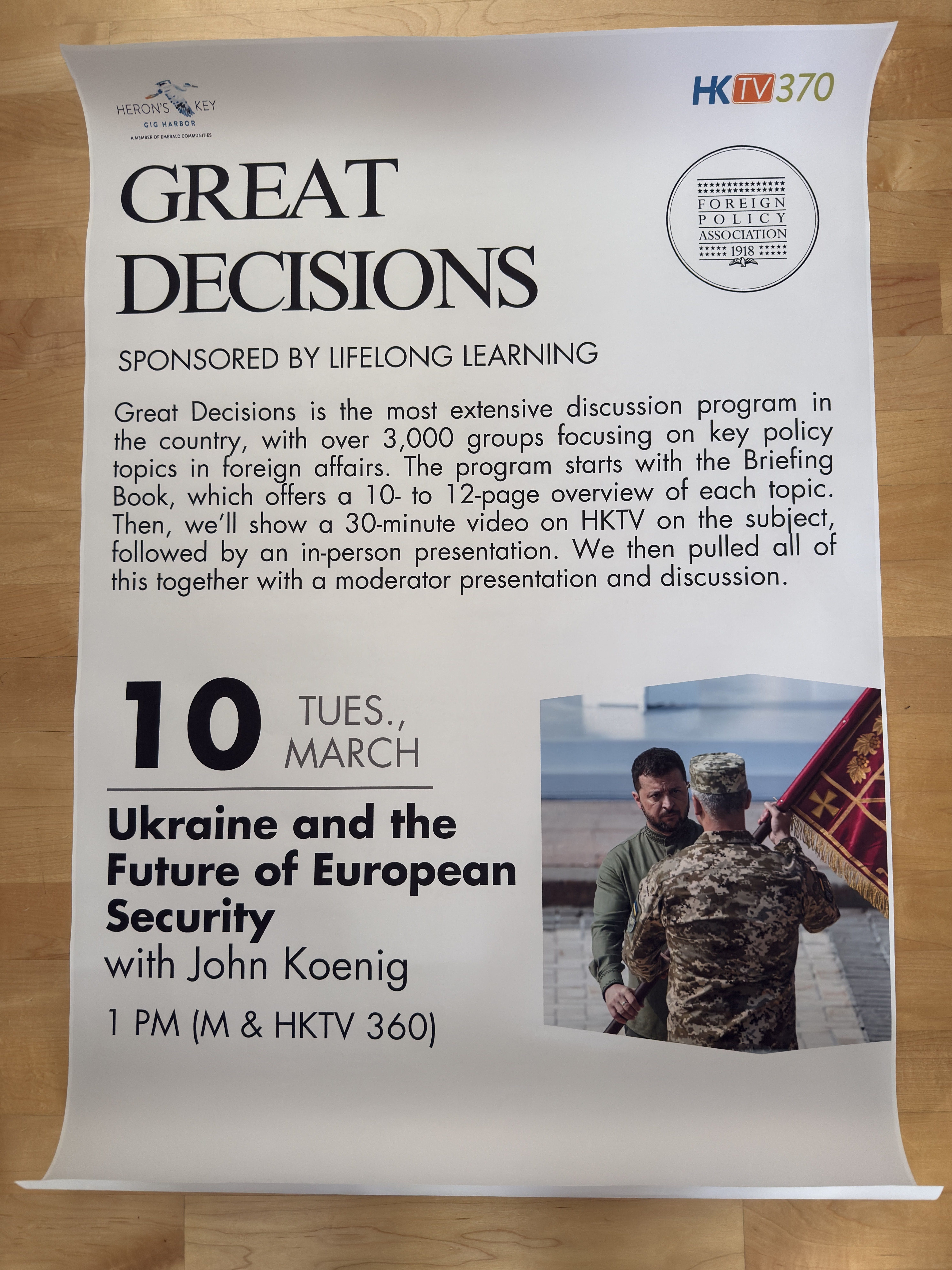
Lifelong Learning is a great thing. The term is typically used to describe a program offered by a university or other institutions, aimed at the continuing education of seniors. I regularly take the opportunity to speak with groups of seniors in Bellingham and around Puget Sound, generally on topics related to transatlantic relations and European security. Just last week I participated in such a program in my home town, Gig Harbor. As usual, the audience was punctual, curious, well-informed and full of comments and questions. I have been asked to speak via Zoom to a Lifelong Learning group in the Washington, DC, area later this year, and I am looking forward to it - especially since many of the participants will likely have backgrounds like mine in government service.
Lifelong Learning is also a habit, one to be cultivated in parallel with another best practice: Unlearning. For someone like me, who spent more than three decades as an American diplomat, Learning and Unlearning are two sides of the same coin. I learned many things over my professional career, important lessons about places and people and the way things work. When I retired in 2015, I suddenly became free to express my personal views in public, building on the lessons I had learned as a public servant. In articles, classroom lectures and seminars, and public speaking appearances, I have conveyed my personal analysis along with recommendations and opinions that were purely my own. This, I believe, is also a form of public service - sharing assessments and judgments formed over the course of many years as a foreign policy “practitioner”.
Over the past decade, I have read more - more widely and deeply - than I could when I was busy as an American official. I have spoken to more people - and a wider variety of people - than I could as an American official, especially in the latter part of my career. I have listened more - more patiently and more openly - than I did as an American official. And I have thought more - more deeply and more critically - than I did as an American official. This is what Lifelong Learning has meant to me, and it has enriched my understanding of a wide range of topics, both policy-relevant and utterly niche or even trivial.
Unlearning - I would even call it Lifelong Unlearning - has been just as important as Learning, for two reasons. It’s not about freeing up disk space.
First, the more I learned through research, discussion, and reflection since leaving the Foreign Service, the more I realized I needed to discard certain assumptions and habits of thought that I had developed during my official career. Unlike many of my former colleagues, I had never been a “true believer”. More than most, I was skeptical of many of the aims and projects of American foreign policy throughout my time representing the United States abroad. I always worked effectively and honestly as a diplomat and carried out my mission faithfully. But as described in an earlier post on this Substack, I sought out assignments and roles that would minimize the cognitive dissonance and moral dilemmas posed by the disconnect between my thinking and Washington policy.
That said, upon leaving the Service, it took time to detect and evaluate my professional habits of thought and decide which to retain and which to discard, to examine the lenses that I had worn for three decades to understand how they had distorted my perceptions. Gradually I adjusted or abandoned more and more of the framework I had employed as a diplomat to analyze events and policies. The impulse was always to go further in revising my take on America and the world. To be more “revisionist” in my thinking.
Meanwhile, over these same years, America and the world were also changing rapidly. This is the second reason that Lifelong Unlearning has been so important to me. It was easier - indeed imperative - to change assumptions and habits of thought when they no longer fit rapidly evolving conditions in international affairs. This created a kind of positive feedback loop between re-examination of my beliefs about foreign affairs and the transformations underway in the outside world. I believe this is a virtuous cycle, even as I am aware of the need for a certain caution and balance.
The dialectic process of Lifelong Learning and Unlearning on a foundation of professional diplomatic experience is what produces the views I share on this Substack. I want them to be provocative - to provoke thought. This morning I went over my posts from the past two years, and I see that I return often to certain topics. One of these is the topic I discussed in Gig Harbor last week in a Lifelong Learning program on “Ukraine and the Future of European Security”. My thinking on these issues has generally been outside the mainstream and continues to evolve. This led me to set aside the video on the topic provided by the Foreign Policy Association and instead present my own PowerPoint, followed by a long discussion with the audience. It went well.
I take the same approach to Lifelong Learning programs as I take for my classes with undergraduate and graduate students. At this point I am no longer a “practitioner” but not quite a “provocateur”. I want to be poised somewhere between the two, to stimulate creative thinking about America and the world. I would define my aims as interrogate, integrate, imagine and innovate: interrogate assumptions, integrate ideas, imagine alternative futures and innovate recommendations. That seems to work with audiences of all ages.
Looking ahead to my presentation to the Lifelong Learning group near DC this fall, I intend to try out a topic that I plan to teach in Rome next spring, alongside my usual European security offering: “The Mediterranean in a Post-Atlantic World”. It weaves together disparate trends and ideas, exploring the links between them. I will swirl the longue durée together with the latest headlines, sketch out big ideas about change in the Atlantic and the Mediterranean spaces, trying to drive Lifelong Learning and Unlearning in a kind of double helix. It just might hang together coherently. I will try to be provocative, even iconoclastic, with what could be a tough audience with incisive questions and comments. That should help me prepare for my students in Rome.
That should be fun. Lifelong Learning and Unlearning should be enlightening, rewarding, enriching - and also good, clean intellectual fun.