Jenga or Restraint?
Managing the Collapse of American Primacy

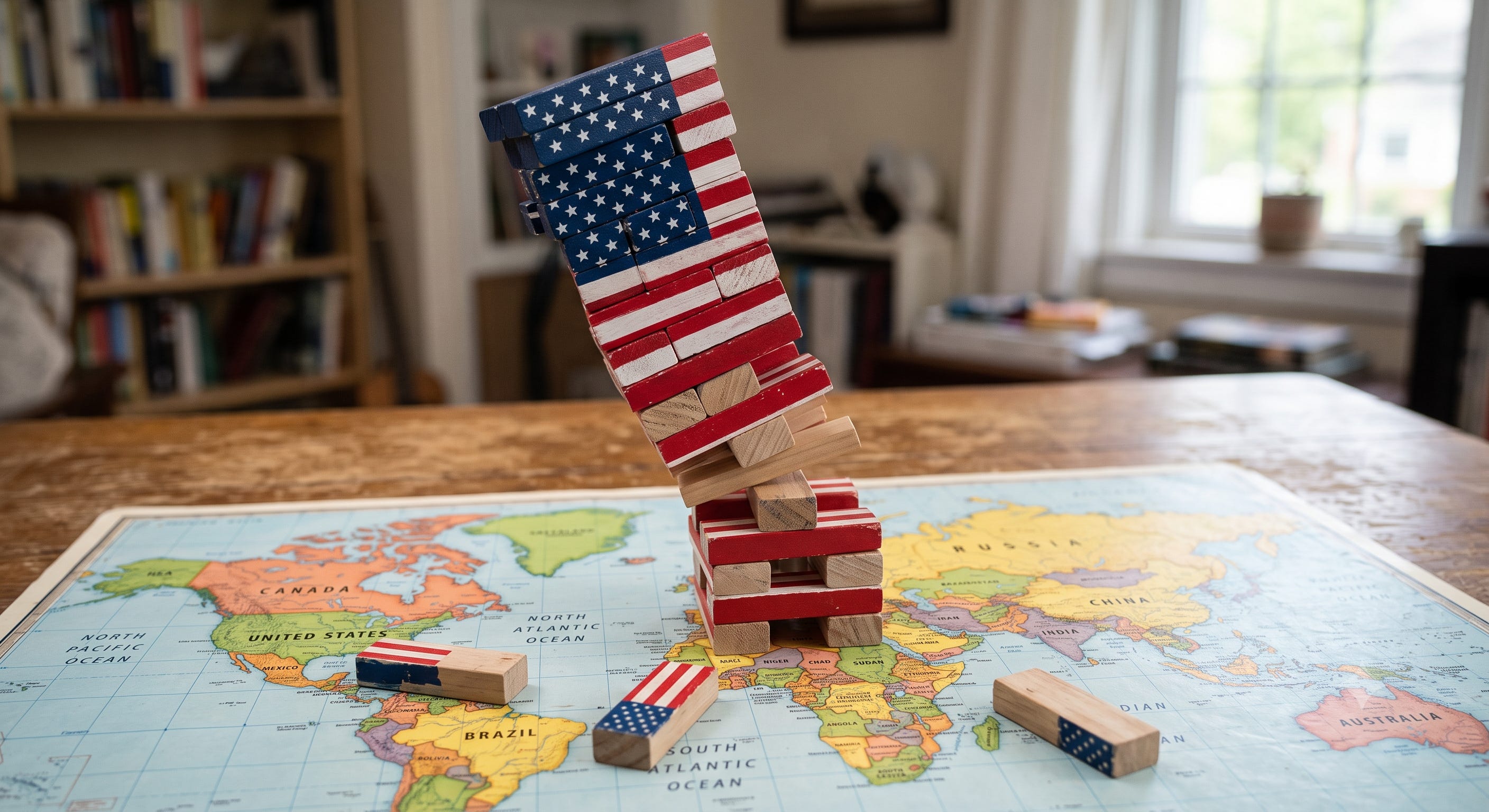
Foreign leaders and policy makers increasingly need to grapple with an America that is growing weaker and weaker while at the same time behaving ever more belligerently. Both wittingly and witlessly, the United States has become the most disruptive and destructive actor on the map. Trump is the proximate cause of this corrosive dilemma of dependency, weakness and malevolence; back in 2016, I already called him the world’s most dangerous man, and he has lived up to the label. In his second term, Trump may have even exceeded my expectations. But it was not hard to foresee the broader trend toward failure long before Trump descended his golden escalator and entered the White House a decade ago. It could have been anticipated for the past 25 years or more, as the precarity of American defense commitments and deterrent capabilities grew ever more apparent. It all reflects the hollowing out of America, the dysfunction of our political system, our incapacity to address existential threats at home or abroad, and an incapacity - at least so far - to change.
Phillips O’Brien has written a great article in The Atlantic on the implications of America’s rapid depletion of its weapons stocks for allies, and then elaborated further in an even better piece for his Substack, focused on the Persian Gulf. Here is a link to the Substack article (which includes a gift link to the piece in The Atlantic):
Phillips Obrien American Age Is Over
Here is a critical point near the end in O’Brien’s Substack piece:
As I mentioned above, the entire security architecture that was constructed by the states in the Persian Gulf and wider Middle East, will have to be entirely remade. There are signs that they already know that. The US, in showing its weakness so dramatically and in adding to that its unreliability and fickleness, is compelling the states to think more regionally.
To my mind, O’Brien is the best military analyst out there and makes very insightful points about strategy, but he can sometimes be too narrowly focused on military matters. I think that is the case here. O’Brien’s analysis hinges on the depletion of key U.S. weapons stocks, the resulting vulnerability of U.S. forward-based and deployed forces, and the consequent collapse of American credibility as a security guarantor in the Persian Gulf. All valid points. O’Brien also makes the right connections to the flawed nature of the U.S. military and the U.S. defense industrial base, and the weakness of national-security decision making in the American system.
But O’Brien does not go far enough, in my view, to address the long-term political and strategic fallacies that brought us to this stage. As I see it, there is a deeper story that has even stronger implications.
At the same time, another analyst I admire, Stephen Walt, has written an interesting article for Foreign Policy on “Why the United States Keeps Losing Wars.” Here is a gift link:
FP Walt Why the US Keeps Losing
Walt, a prominent realist scholar, points out that the U.S. keeps losing because it chooses to fight the wrong wars - wars that are unnecessary, in which our adversaries are far more committed than we are, and which cumulatively weaken America over time. Walt is a major critic of the foreign and security policy establishment, or The Blob, and he correctly ties the failures of U.S. military engagements abroad to the complete lack of accountability and self-awareness that prevails in the unapologetic American foreign and security policy establishment (citing Robert Kagan as an example).
All valid points, again, but Walt also does not go far enough.
Leading lights in the foreign and security policy establishment like to scold advocates of restraint and other critics of American primacy by saying “you will miss the rules-based order when it’s gone.” But it is gone, and it has been gone for two decades, and that was largely the work of the American foreign and security policy establishment itself. What was built up in the post-Cold War period was not just hypocritical or unduly self-serving. It was entirely unsustainable, based on a lie about power, shared values and solidarity that was never close to true. The fallacy of American credibility. As the United States has grown steadily weaker, the fallacy has become more obvious.
The broad points that O’Brien and Walt make - poor military planning at every level, a mismatch between level of ambition and capacity, disastrous strategic choices and a lack of accountability - have been glaringly apparent since at least 2004. By that time, it was already clear that the invasion and occupation of Iraq and the counter-terrorism and counter-insurgency operation in Afghanistan were headed for failure. In the intervening years, the United States has opened new overseas military bases, broadened its military strikes on nonbelligerent countries, enlarged the North Atlantic Treaty Organization, undertaken more security commitments outside Europe, and lost two major wars - Iraq and Afghanistan - and many minor interventions.
Through it all, until the advent of Trump’s second presidency, allied foreign governments and the American foreign and security policy establishment behaved as though nothing was fundamentally wrong. As though the entire house of cards that we were building was somehow sustainable despite the profound weakness at its core: the United States.
America in the 21st Century is a country that cannot build infrastructure, a country that cannot address systemic problems, a country that does not respond to popular will. It is an increasingly feeble, oligarchic state and has been now for two decades or more. We are not without sources of potential strength. The size of the United States and its economy, the wealth it has accumulated over many decades, its favorable geographic position and resource endowments are inherent sources of strength. But we have squandered our resources, mainly to the benefit of the most affluent, through increasing their private wealth and bending our public spending in ways that disproportionately protect and benefit them.
Why is that?
Much commentary on America’s obvious failure to develop effective solutions to systemic problems focuses on political polarization, as though that were an independent factor that arose and persists out of some inherent feature of technological progress or human psychology. To my mind, political polarization is a symptom of our fundamental systemic failures, not the cause. The causes are deeper: our neoliberal, financialized and increasingly oligarchic and monopolized economy; the institutional capture of key institutions by the wealthy and other entrenched, narrow interests; the easily exploited flaws of our constitutional and legal systems. These are the drivers of not just our weakness, but of an emerging sense of fatalism. Our most basic problems, we seem to believe, are just too big to fix. We can’t control guns or regulate crypto currency; how could we possibly regulate AI or decarbonize our economy? Galloping climate change, rampant inequality and inequity, a dysfunctional system of for-profit health care, disruptive and intrusive technology, the enshittification of everything - there are no public solutions for these problems. We seem to agree that each of us can and should look out for ourselves, our families, our friends and communities. As a larger society, though, as a nation, we are hopeless. That is the prevailing vibe, in my view, which tends to suffocate new ideas and public initiative.
Such fatalism is not confined to the United States, but it is worse here, and it matters more here because of America’s impulse to dominate the world. I focus most of my thought on foreign affairs. This is where The Blob’s lack of imagination and devotion to serving power are most destructive. Apart from nostalgia for a more benign past, the American foreign and security policy establishment cannot imagine a better world than this one. Seriously, it is focused on American primacy and how to obtain it, to “restore” it for the most part, and a thousand other specific and relatively minor problems, rather than the most fundamental strategic question facing us and the world: managing America’s decline. Those words - “managing America’s decline” - are anathema to most of The Blob. They are so stewed in American Exceptionalism and the sense that their role is to realize that delusion rather than escape it that they deny the “inconvenient truth” of American decline. Every U.S. failure is a “setback”, every strategic blunder or cruel act of international vandalism is a case of “falling short” of our noble aims on behalf of Americans and all humanity.
It is worse than a waste. It is in itself destructive.
I think the best minds in America and abroad should be focused on how we can address the truly existential threats facing us in ways that minimize harm to humanity. Things like global warming, pandemic disease, disruptive technologies, global inequality. Peace, to name an aspiration that hardly registers in today’s foreign affairs lexicon. To the extent that foreign and security policy types apply their energies to geopolitics, it should be in finding ways to manage America’s decline (whether relative or absolute; I think both apply) in order to minimize the terrible risks that process entails: for war, for environmental destruction, for distracting us from the truly existential dangers we face.
We need to be able to imagine a world in which America does not have military bases around the globe, does not devote most of its discretionary budget to the military, does not engage in thoughtless and destructive wars with impunity, does not seek to dominate the rest of the planet. By “we”, I mean people everywhere, not just Americans. We need to have a vision for a better, safer world that does not rest on the illusion of American power in a time of American weakness. “Peace through strength” has been a lie for most of my life; “extended deterrence” was always a game of three-card monte. The entire system has been moving toward collapse, and is now a wobbly Jenga tower that threatens to topple and destroy everything around it.
Will we have the sense to start removing the top pieces of our Jenga tower and rearranging the whole game to be flatter, more stable, more equitable than what we so foolishly built up over the past two decades? Frankly, I doubt it.
Both O’Brien and Walt make a point to say how much they regret having to point out the weaknesses of the United States and our costly strategic mistakes. Such elegiac laments are de rigeuer in American policy writing, an obligatory nod to patriotism, I suppose. But how do we expect the United States to mend its ways if it never pays for its mistakes? Walt in particular stresses the corrosive impunity of the foreign and security policy establishment, the lack of accountability of key figures for even catastrophic mistakes. What does accountability look like if it is not based on driving home the damage being caused by the errors we continue to make?
O’Brien is better than Walt in this regard. But again, neither goes far enough, to my mind. If we don’t learn our lesson from this war with Iran, from this emerging AI disaster, from this gathering climate maelstrom, how will we correct course before it is too late? We need to recognize the failures of America and American primacy for what they are - the signs that we need to make a fundamental change in our approach, to rethink what we want and imagine a better world.
We need to get started. Now.
Time is short. The cascading planetary disasters are telling us this. Fatalism is not the answer. Nor is winning or “bouncing back.” We need better ideas, more focused on humanity and our shared fate.
We are teetering on the edge of the abyss.
“enshittification of everything”