Is New Management What We Need?
The empty, technocratic promise of The Blob's political engagement

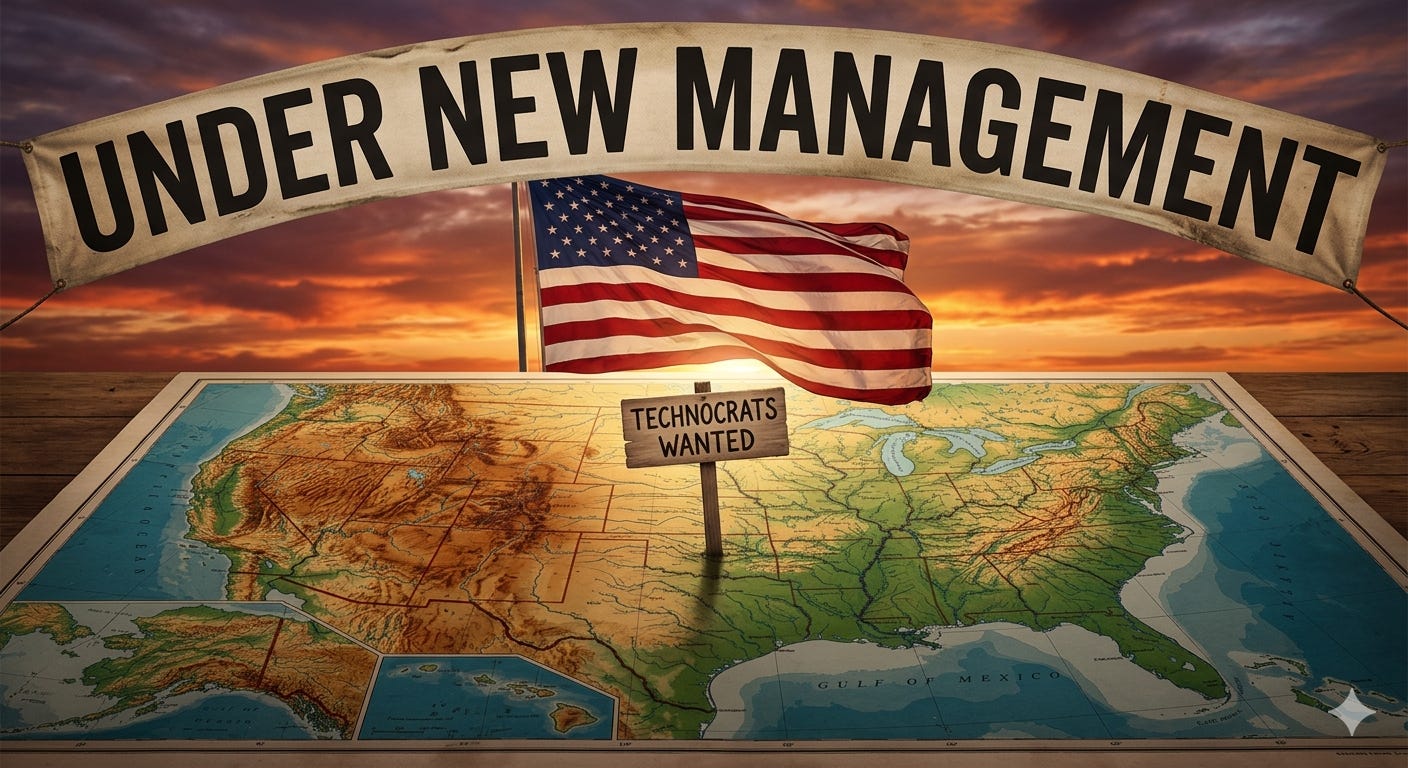
Jamelle Bouie’s column this morning in the New York Times lays out the ongoing transformation of the United States into a new Regime under Trump, one guided by Project 2025 in both vision and execution. Bouie highlights the Democrats’ lack of any such unifying program of action or even thought. Indeed, in Bouie’s analysis, the thought must precede the action. It must be based on a clear ideology (even if Bouie does not use that word, which has come to be regarded as a pejorative in American political discourse). Bouie suggests a set of goals that would entail major adjustments to our governing laws and constitution, driven by a clear concept of the relationship between the individual and the state and of the social and economic underpinnings of government. Without such an ideology (my term), Democrats’ drives for national renewal will inevitably come up short. They will be about restoration rather than “reconstruction”.
Bouie takes down current Democratic thinking about a possible Project 2029, a proposed response to Project 2025. In Bouie’s words: “A Project 2029 cannot be a collection of Democratic Party agenda items. It must articulate a broad new conception of the nation’s political order — one that will guide the way a future Democratic-led government might wield power. Above all, Democrats must have a plan for reconstruction — for building something new on the wreckage of what President Trump, MAGA and the Republican Party have wrought — not restoration of what was.”
Here is a gift link to Bouie’s article. Give it a read:
NYT Bouie America Broke Something
I fully agree with Bouie’s column, but I would go further and deeper. To my mind, even “reconstruction” is a dangerous, backward looking term. It is the wrong frame of mind. We should be talking about a revolution. A “political revolution” as Bernie Sanders has called it. I would also apply Bouie’s ideas at the personal level and suggest that they help to define the conditions for effective political engagement by individuals.
National Security Technocrats Are Not the Answer
Here is where I part ways with many of my former colleagues in The Blob.
I am a member - though an inactive one - in a couple of networks of former national security officials which engage very actively in public debates and even partisan political contests. There are a few other, similar networks out there that I am aware of. To their credit, they frame their political engagement very much in terms of reconstruction and renewal. The networks wear their (purportedly) non-partisan character on their sleeves, proudly, asserting that their record of public service under both Democrats and Republicans bolsters their claim to a special role in saving and restoring our Republic.
I think this is admirable in a way. These are networks of good citizens, with a strong sense of civic responsibility. These people show up. But their appeals and their claims have always made me uncomfortable. They do not embrace an ideology, they have no unifying vision of the fundamental shortcomings of the American state and what is needed to overcome them. They are united, instead, by devotion to the constitution and its governing institutions. To restoration (even though they protest otherwise). They take a managerial approach to politics and government.
This is one reason I don’t really engage with these groups (the other being that I doubt their effectiveness). Don’t get me wrong - I value experience and expertise and believe they should inform our politics and policy. And I share with these non-partisan crusaders their outrage at the behavior of the Trump Regime. Many of them are my former colleagues and friends (in some cases former friends). But I am much more inclined than they are to trace our present crisis to long-term, systemic rot under both parties. And also to our economic system; especially to our neoliberal system, which is increasingly characterized by primitive accumulation. I am inclined to regard the whole paradigm for ex-Blob public engagement - as exemplary former non-partisan civil servants and guardians of our republic - as a delusion, as a kind of technocratic gambit.
The groups of foreign and security affairs veterans that I know would deny that they believe in technocratic rule. But they - we - can’t really escape our own past, and they don’t even want to do so. They embrace it. It is the foundation of their claim to an enlarged role in our national debate. At a time of blatant corruption and mind-boggling incompetence, technocratic rule undeniably has a certain appeal, potentially broader than it ordinarily would. And - if we’re being honest with ourselves - I think American national security officials have always been attracted to the notion that technocrats should be in charge in the United States and other countries. In other words, that “people like us” should have more authority to manage affairs.
I don’t think “new management” is what America needs. Technocrats are not the answer. America needs a new system. Our current system is not just morally bankrupt and facing insolvency; it is terribly destructive both at home and abroad. The constitution is part of the problem, but the roots of our grinding self-destruction go much deeper.
Ideology and the Two-Party System
To be honest, the majority of these self-proclaimed non-partisan national security veterans side openly with the Democrats these days, and for obvious reasons. What choice do they have? Trump and his Regime-in-Becoming are a mess, an outrage. A large swath of Democrats, including the core Democratic Party establishment, are institutionalists. They value the form of government as much as the substance, and believe playing by the rules is the essence of good governance. They have a managerial approach to politics, and this appeals to folks like us. Folks from the foreign and security policy establishment. In other words, The Blob.
I also vote for Democrats. In the American two-party system, there is really little alternative for anyone who cares about policy and our national life. I am happy to see national security alums get elected on the Democratic ticket. (I have real problems, though, with the security state alums who are being elected with the GOP. More on this in an upcoming article.) Still, I am not sure I have more in common with these foreign and security policy engagement networks than that - my voting pattern.
The thing is, I have an ideology - I am a leftist. Even though I was scrupulous in serving faithfully both Democratic and Republican administrations as an American diplomat, I never stopped being a leftist. Not a communist, for heaven’s sake - that is a political identity that became too closely associated with Leninist parties and authoritarian regimes over the course of the 20th Century for me to support. I lived in East Germany; how could I possibly be a communist? For Americans, communism - 35 years after the end of the Cold War - is still the “great satan.” But I am a kind of socialist, a person whose views on socio-political and economic developments have been shaped by Karl Marx and the rich tradition of philosophy, historical analysis, and policy ideas that grew up around Marxist thought. In other words, I embrace the “small satan” in American political parlance: socialism. I am particularly attracted by world systems theory and, as I have lately come to realize, Antonio Gramsci.
Some of my former colleagues have expressed surprise bordering on astonishment that I have such an ideology, and that I held it while serving in the Foreign Service. They could not detect it in my work. That is a good thing. And they suspect - correctly - that my ideological viewpoint has sharpened since I retired in 2015. My circumstances have changed, the world has changed, and I have changed.
Even though I did not flaunt my ideology as a diplomat, it has never stood in contradiction to my loyalty as an American, either during my Foreign Service career or today. I think the American system is profoundly flawed, and that fundamental change is needed to better protect and advance the interests of the American people. The Trump Regime is trying to silence alternative ideologies and impose individual political and ideological “fidelity” on the Foreign Service and other groups. This is an ideological assault from the right. I believe we all should resist it, and our prospects in this struggle will be much better if we have - as groups and individuals - a clear ideological basis.
I do not regret that I served both Democratic and Republican administrations loyally and to the best of my ability. It was a condition for my employment, not something to boast about or be particularly proud of. During my time as a diplomat, it was sometimes complicated or awkward but never all that difficult. I always had in mind a set of tripwires that would cause me to resign from the Foreign Service if sprung. When colleagues went off to work at our diplomatic posts in Iraq during the U.S. occupation of that country, either out of a sense of duty or curiosity or ambition or simply succumbing to the pressure of our HR system, I just scratched my head. Iraq was a tripwire for me. I would not go, even if ordered to do so. I managed to avoid it, and when it loomed large at one point, I temporarily left the Foreign Service.
Those tripwires were tied to my personal integrity and ethics - which in turn are tied to my ideology more than the words of the U.S. constitution. I always upheld the constitution, but what does that even mean? Constitutional issues rarely landed in my inbox. The constitution is a flawed document, and hardly a guide to personal ethics and behavior. Ideology is both broader and deeper. For some that ideology is religion. For me, it is leftist social and political thought. It is there that I find my sense of right and wrong, my sense of ethics. My sense of justice. The rules tell us to serve. My ideology tells me to think.
The Managerial Class
It is the devotion to the constitution and non-partisan service that, to me, renders the networks of former national foreign and security policy officers so ineffectual. They can claim some electoral success, though their distinct contribution - apart from the usual mechanisms of writing checks and knocking on doors - is debatable. Governor Spanberger in Virginia is their most prominent success story and their hero. But they are, as a group, unfit for the role of rebuilding America. They are devoted to form. If they have an ideology, it is liberalism, a relic of the past that has, in recent decades, provided an ideational framework for neoliberal economics. Rather than deal with the messiness of that ideology, they prefer to speak of patriotism. I believe their intentions are noble in that regard, but patriotism is a shape-shifting chimera. It defines nothing.
What unites them is experience in the national security state that the United States built over the past 30 years. The individual participants bring their own distinct experience, point of view and even ideology to the mix. But the foundation of their engagement is what they have in common. And what they have in common is the national security state. Uniting under this banner, they do not eschew the national security outlook or label; they embrace it. They are mainly managers, institutionalists. They market themselves as exemplary national security officials, unswerving in their patriotism and loyalty to the constitution.
This bothers me. It is a point of failure for foreign and security policy veterans as a sort of vanguard of national renewal. We all share - myself included - the imprint of, and even some responsibility for, America’s disastrous foreign policy over the past three decades and the metastasis of our national security state. The definition of national security that we imbibed over many years is an albatross around our necks.
Patriotism is the Last Refuge of a Scoundrel
As Samuel Johnson said, “patriotism is the last refuge of a scoundrel.” He was inveighing against imperialism and slavery, not just the cynical manipulation of nationalist feeling to evade responsibility for misdeeds and corruption. Like Samuel Johnson, my concerns about the centering of patriotism as an organizing principle are moral. They focus on imperialism and oppression - American imperialism and oppression.
It is crucial, in my view, that those entrusted with authority have a firm, personal ideological or moral foundation - especially those in the national security field, including the American security state. But that ideology is exactly what we DO NOT have in common. It does not exist in the constitution and cannot be reduced to patriotism. They surely do not need to hold my leftist ideology, but they should have core principles in some form that underpin and focus a perspective on social and economic relations and “values.” It should be systemic and conscious. It should be an ideology.
The very concept of the managerial approach, non-partisan loyalty to the constitution and unwavering patriotism and faithful obedience to legitimate leaders, is the negation of all that. It stands in great tension to ideology and individual conscience. It is the wrong banner for effective and meaningful engagement toward a different future. It is the very embodiment of restoration.
Oliver Kornetzke, in his outstanding Substack, has written an incisive takedown of the Democratic Party elite based on class allegiance and dependence on donors. I highly recommend it and share most of Kornetzke’s judgments (though I lack some of his impressive blue-collar credentials):
I believe that most of what Kornetzke says about the Democratic Party elite applies to the networks of ex-Blob types who have organized to support, by and large, the Democratic Party in opposition to the Trump Regime. But foreign and security policy veterans have a special responsibility, a kind of collective guilt in my opinion. We were part of the problem. We had roles - large or small, central or peripheral - in the unfolding of a colossal, long-term national failure. And unless we change our outlook, we will remain part of the problem, not part of the solution.
One can argue, of course, that we were just taking direction. We were just following orders - legitimate, legal orders. And that it wasn’t about ideology, really, just the law and the constitution. But were we really so powerless? The disavowal or compartmentalization of ideology and partisanship does not actually mean the absence of ideology or partisanship. It means the instrumentalization of the individual in the service of some ideological or partisan purpose. Are we really ok with that?
Loyalty is a limited and very conditional virtue. It depends crucially on the object of ones devotion, of the program in which ones loyalty is engaged. Morality should never be “above my pay grade”. I will write more about that in another article in the next week or two. For now, each of us should be responsible not only for obeying lawful orders and rejecting illegal ones, but for understanding and even foreseeing the moral consequences of the actions we take. We should not elevate loyalty - to an individual, an institution, or the constitution - to a more exalted place than it deserves.
Foreign and security policy alums have as much right as anyone to a voice in our national debate and a role in our national life. This is (still) a free country. But ask yourselves: Having followed orders with discipline, fired by a sense of patriotism and national purpose, have we really demonstrated a capacity for leadership? Especially now, as our country is in crisis. Is our shared experience a source of ideas for a new era in American life? Have we shown that we have what it takes to guide America on a new path - or even see where it might lead? Are we and our former colleagues really the best candidates, the ones who deserve support for elective office?
They are like us; isn’t that a problem?