Formative Years
How a month in Pakistan in 1973 changed my life more than I realized

I have often said that spending December 1973 in Pakistan changed my life. My parents sent me to accompany a friend, Barbra, who was visiting her family at a mission clinic north of Rawalpindi. I had just turned 15. After that, I was hooked on the world outside the United States. I embraced a dream of becoming an anthropologist that I ultimately discarded to join the Foreign Service (that is another story).
I brought back a lot of great photos from that trip, some that I took myself and others - the best ones - taken by David Mitchell, Barbra’s brother-in-law. We spent a day in Karachi, hung out in Abbottabad, made road trips to Peshawar, the Khyber Pass, the ruins of Taxila, and Lahore, collecting wonderful images and memories along the way.
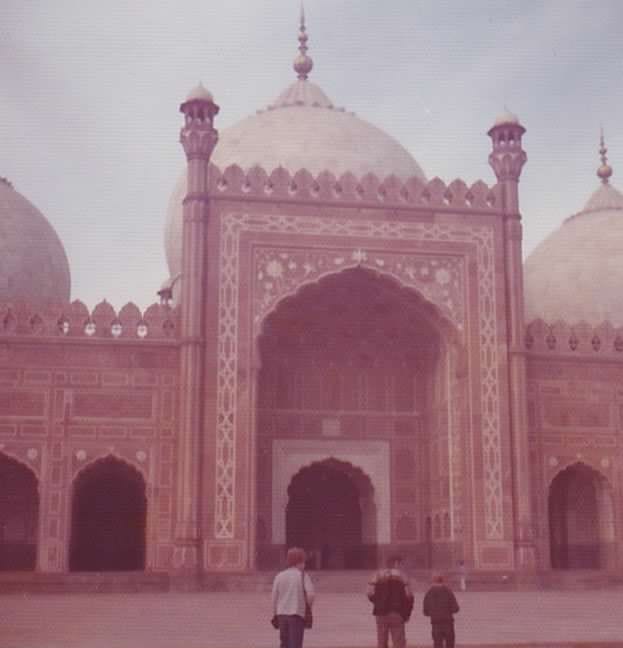
I only have two fuzzy pictures from the Badshahi Mosque in Lahore, both taken on Barbra’s little Instamatic. In the photo above, I am walking with David and his son, Jonathan, toward the main prayer hall of the Badshahi Mosque. Over time I have come to realize that those few days in Lahore in 1973, and especially the visit to the Badshahi Mosque, set me on a mental path that would never converge with most of my colleagues in the Foreign Service and the American foreign and security policy establishment.
I just couldn’t be all that impressed by the United States anymore. I could never understand, let alone embrace, the notion of American Exceptionalism. For me there was no grand American project, no “national purpose”, no mission or message to the world emanating from America an sich. The United States was just a normal country; what set it apart was the refusal of many Americans - perhaps most - to accept that reality. America was favored by geography, large, wealthy, with its own set of joys and troubles, and its own rather short but dramatic history. Otherwise the U.S. was just like the rest of the world - like the rest of humanity. It caused problems for itself and others when it embraced the illusion of American Exceptionalism and sought to impose its will. When, in the parlance of the foreign policy establishment, it tried to “lead”.
What does this have to do with the Badshahi Mosque? It’s about the formative years of a curious and sensitive kid. Me.
I grew up in the Puget Sound region and had an idyllic lower middle class childhood with some special perks, like the boats that my dad bought and fixed up for our family and summer vacations in the San Juan Islands. When I turned 15 I had never traveled further than British Columbia. The most impressive buildings I had seen with my own eyes were the BC parliament in Victoria, the Smith Tower in Seattle, and Husky Stadium at the University of Washington. I loved to lose myself in distant places in the huge collection of old National Geographics my grandparents kept in their hall closet, and I also enjoyed the films about foreign countries we watched at Curtis Junior High.
Then, out of the blue, I was flying over the Nile Valley on the way to Pakistan. Once on the ground - in Karachi, in ‘Pindi, wherever we went - I was overwhelmed with everything. It was everything, everywhere, all at once.
Among all these intense and vivid experiences, the Badshahi Mosque was profoundly different. It was easily the most impressive structure I had ever seen. Indeed, even now, 53 years and 60-odd countries later, it would still make my Top Ten. It was grand and austere and utterly beautiful, and the vast courtyard - the largest of any mosque in South Asia - was quiet. Amidst the furor of Lahore, the glitter and dirt and noise, it was tranquil, just distant city sounds, the rhythmic sweeping of palm fronds on stone, and hushed voices in alcoves. This, I thought, is a place of dignity, a magnificent place of worship, a place that elevates humanity.
I knew then, and I know better now, that the Badshahi Mosque was built in the mid-17th Century by the Emperor Aurangzeb, a cruel man who extended the Mogul Empire’s boundaries into south India but wasted its energies on religious dogmatism and conquest. The Mogul Empire flamed out, in a way, with Aurangzeb, although it endured in some form until extinguished by the British East India Company in 1857. But that does not detract from my admiration for the Badshahi Mosque.
Last year I had the chance to visit the Jama Masjid in Delhi, which was built by Aurangzeb’s father, Shah Jahan, whom Aurangzeb deposed to seize the throne. It is sometimes called the model for the Badshahi Mosque. Compared to the Badshahi that I remembered so clearly, however, the Jama Masjid seemed small and too dainty, all scalloped fussiness. Not so the Taj Mahal in Agra, also built by Shah Jahan, which I saw later on the same trip to India. The Taj Mahal is breathtaking. But I was no longer the impressionable kid I was in 1973.
I have seen so many great things in the world since that December 53 years ago. The Taj Mahal, Angkor, Petra, Istanbul, the Vatican, the Great Wall, the Potala, the Registan in Samarkand, Rio from Sugar Loaf - all of these are imprinted on my mind. My favorite built structure of all may be Sagrada Familia in Barcelona. And there is nothing to compare with the three sunny days I spent in Antarctica a few years ago.
But the Badshahi Mosque changed my life. How could I feel that America’s achievements were uniquely important after seeing this astonishing achievement on the other side of the planet? How could I believe our ideas were exceptional and our talents unmatched when I saw what others’ ideas and talents had created? How could I imagine that destiny had something special in store for the United States once I knew what had become of the creators of the Badshahi Mosque and the Mogul Empire? Aurangzeb was a fanatic Muslim, but Islam is a tolerant faith - or at least as tolerant as other faiths. I saw that again in Indonesia, and have never doubted it.
Across the world, across boundaries, across cultures, it is our common humanity that calls out for us to listen, to understand, to find ways to improve our lives and those of our fellow humans. To my mind, appreciation of this simple truth was never manifest in the Foreign Service, the foreign and security policy establishment (or, as I often call it, The Blob). Most of my colleagues, as I recall, had more faith in a national purpose, the U.S. constitution, and our policy objectives. They found more inspiration in America. I don’t fault them for that. I was just different, not better. For me, it was always more the region where I grew up and then the world, all humanity. The structures in between were all relative, interesting taken as individual entities, fascinating when taken as a whole. The nation never meant as much to me.
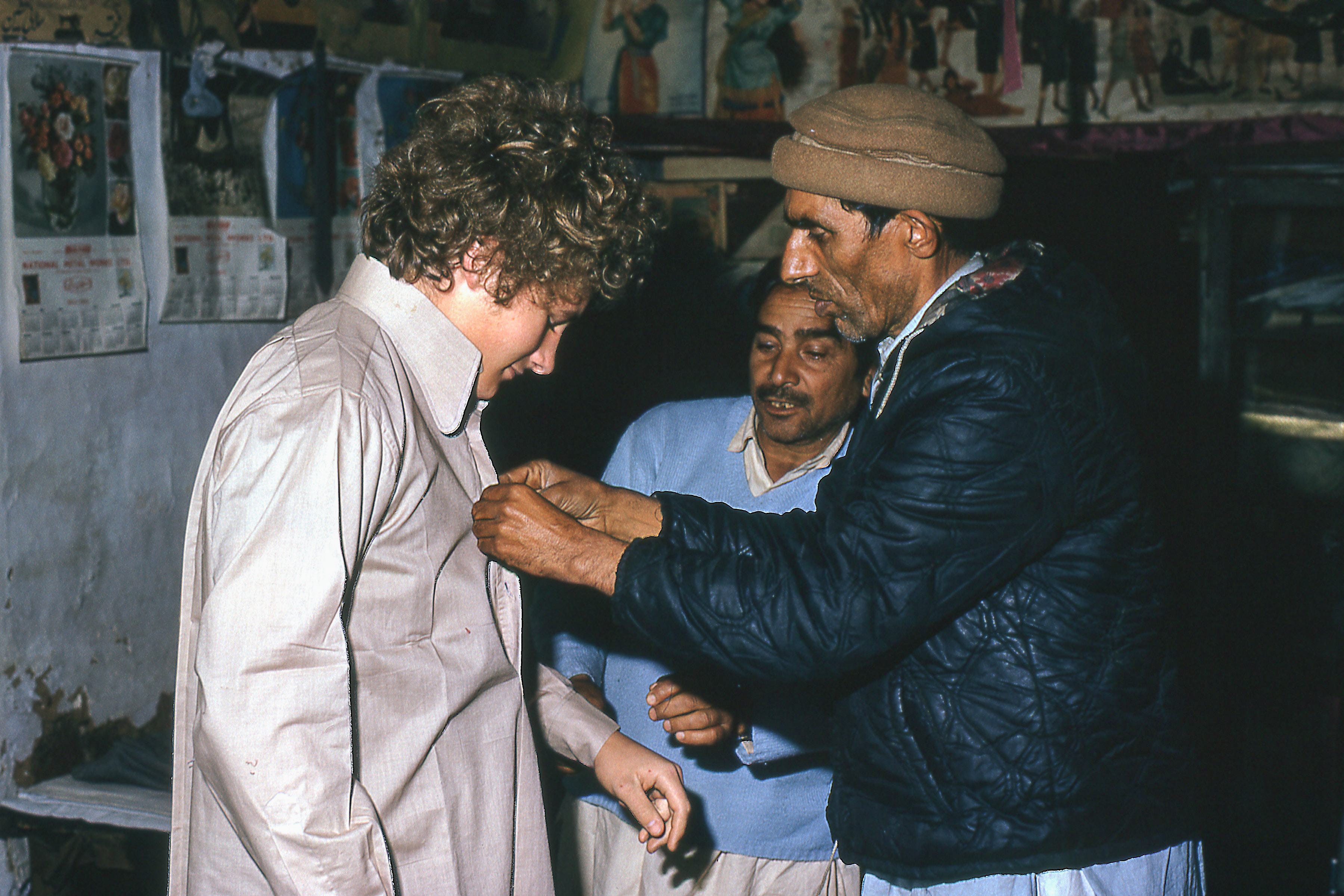
I am astonished I did as well as I did in my profession. I was not a fraud - I was a loyal, dedicated American diplomat. I worked hard. I wore a suit to work when I had to - which was most of the time - and did my best to advance our policy aims. But in my mind I never really took off the kurta pajama that a Pakistani tailor made for me in Abbottabad in 1973.