Blob Slop
It's Always Groundhog Day for the Foreign Policy Establishment

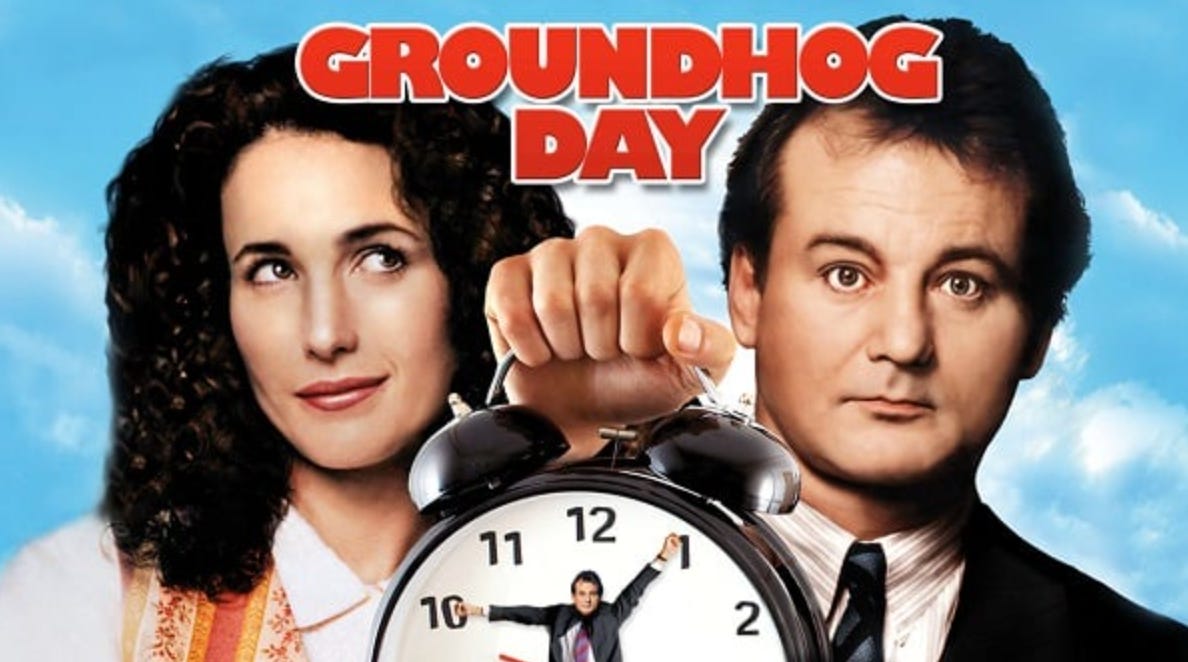
The Blob - the American foreign and security policy establishment - is generating ever more slop. Writing the same article over and over again, from the same worn-out perspective of “great power competition” and “American exceptionalism”. Tweaking a phrase here and a sentence there, throwing in a new metaphor. And managing to do it all without much help from AI!
Peter Beinart has written an excellent piece in today’s New York Times that calls out America’s foreign policy hawks for failure to learn any lessons from our disastrous wars over the past 25 years. Beinart also highlights the failure of our system (such as it is) to hold the hawks and jingoists to account. Here is a link:
Beinart NYT Foreign Policy Failure
Beinart could have gone further. He does not explore the reasons for the astonishing and persistent impunity of our most aggressive foreign policy blowhards - people like Lindsay Graham in the Senate, former National Security Advisor John Bolton, Bret Stephens at the New York Times, and, more recently, Matthew Kroenig at the Atlantic Council. One gets the sense, to be honest, that the “system” is designed to deliver impunity for warmongering. Much has to do with our oligarchic neoliberal economic system, as I see it, and the pervasive delusion of American exceptionalism, on which generations of American children have been raised. Aggressive foreign wars are integral to our economic and political system.
I fault The Blob for fostering and serving this system, but it is in the nature of the foreign and security policy establishment to serve power. Beinart’s op-ed notwithstanding, the New York Times and other major publications are a big part of the problem. It was only today, for example, that the NYT pointed out that Trump’s claim to have achieved a great breakthrough by securing Tehran’s promise not to develop a nuclear weapon - a claim Trump has been boasting about for two months already - is total bullshit. Iran has made the promise repeatedly in the past, and experts do not believe it matters very much. (One might ask, in light of Trump’s cancellation of the JCPOA and U.S. behavior more generally, why these “experts” lend more credence to American promises than to those made by Iran.)
The corruption of think tanks, in particular, is just like the profound and all-pervasive corruption of our political system in general. It is inseparable from the concentration of money and power among an increasingly oligarchic elite. The Blob repays its patrons through what it says and what it doesn’t say; what it highlights and what it ignores.
But there is a deeper problem for The Blob and especially for the Washington think tank world. It is out of ideas, and the endless repetition of the same nonsense and misdirection is ever less persuasive and more off-putting. I used the Groundhog Day metaphor in the title, but The Blob is also more and more like a hamster wheel. Running in place, meaninglessly, generating content for itself and a narrow audience inside the Beltway (and in Brussels and other capitals).
There are still some excellent analysts out there. I have to say that Phillips O’Brien has impressed me greatly over the past year, and I am still a big fan of Van Jackson and a few others with a broader or adjacent field of analysis, including Paul Krugman and Adam Tooze. There are still credible think tanks, though they generally have a lower profile than the Council on Foreign Relations or Brookings, and are more “niche”. But they are the exceptions.
Foreign Affairs (affiliated with the Council on Foreign Relations) and Foreign Policy, the flagship journals and websites of The Blob, are drowning in slop. They regurgitate the same essential articles day after day, week after week, with very little analytical variation or innovative perspective. The bylines change but the content remains the same. The same themes and conclusions repeat themselves in an endless loop. It is always Groundhog Day. China does not seek to replace the U.S. as global hegemon, exactly, but it is still both very dangerous and much weaker than most of us think. Europe needs to build out its strategic autonomy but remains dependent on the United States for now and for some years into the future. An Iranian nuclear weapon would be a colossal problem for the Middle East and the globe. International law is irrelevant, a gauzy anachronism that serious countries ignore. We all need to devote more and more of our resources to defense.
Guns over butter is the flavor of the day/week/year/decade.
It reminds me of what NATO Secretary General George Robertson used to say of the North Atlantic Council when I worked at NATO Headquarters in Brussels: “Everything has already been said, but not everyone has said it.” I don’t know whether Robertson coined the phrase, but it was totally on target. Amid the sea of words, it was hard to discern much that had any real meaning or significance. It was all performative. What stood in for deliberation when all the direction was coming from Washington.
Foreign Affairs and Foreign Policy are models for the degrading effect of our current information environment, characterized by senseless immediacy and sensory overload. They are both - but especially Foreign Policy - invested in their online presence. Their monthly or quarterly print editions have faded into the background as the so-called “journals” are busy chasing exactly the same audience as the New York Times or CNN or BBC. But they are not good at it (al Jazeera and the BBC are much, much better). They generate slop. I scroll through their menus and tune into their webinars and find nothing - NOTHING - of any marginal value. It’s a dreary slog through repetitive junk.
I know that FP and FA still get clicks and that a few folks follow their online conversations, but the whole endeavor is such a waste. A waste of the audience’s time and a waste of whatever the contributors might produce if they took a moment - maybe a week or two - to reflect. To ask themselves what the hell they are doing. If they took a break from generating content to think more deeply and apply their expertise - which is often real - to generating, now and then, a useful insight, novel perspective, or helpful recommendation.
There is opportunity cost to running on the hamster wheel, to feeding Groundhog Day. I want to call it Ground Blob Day.
For now, however, they are “flooding the zone”, to use Steve Bannon’s famous phrase. Creating fog and distraction. Feeding AI training day after day with the same bad ideas and superficial analysis - probably climbing up the ladder of search results. All in all, just wasting our time. Wasting my time. And wasting my money - I eagerly look forward to the day when I have taught my last class and can cancel my subscriptions to Foreign Affairs and Foreign Policy. When I won’t need to know what appears there in order to seem au courant with what’s happening in The Blob.
In their small and wonky way, the think tanks and “journals” and foreign and security policy establishment are propping up the oligarchic system based on defending American primacy and elite impunity which they are disposed to serve. I have better things to do than watch them bow and scrape and consume their slop.